|
• A feature marking the quartoseptcentenary of the mother of all Madras business chambers
On September 29, the Madras Chamber of Commerce and Industry held its 176th Chamber Day. It marked the end of a year-long quartoseptcentennial celebration of one of the oldest Chambers of Commerce in the country. The Calcutta Chamber was the first, founded in 1833, but it folded up a few years later, only to be reborn in 1853 as the Bengal Chamber of Commerce. The Bombay Chamber is, therefore, technically the oldest surviving chamber today, founded as it was on September 23, 1836. A week later, on the 29th, was born the Madras, Chamber.
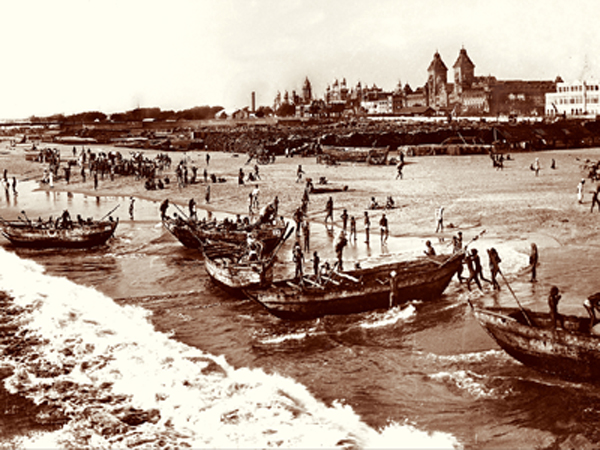
Masula boats and the cargo they unloaded piled up on the beach fronting First Line Beach. The scene before the Madras Chamber succeeded in getting Madras
Harbour built. (Courtesy: Vintage Vignettes.)
|
On that day, a group of businessmen, all English, met at the offices of Binny’s in Armenian Street and resolved to found a Chamber of Commerce for Madras Presidency. Prominent among them were representatives of Arbuthnot’s, Binny’s and Parry’s, the three leading business establishments of the Presidency. The monopoly of the East India Company over Indian trade had ended three years previously and free-merchants, long flourishing but not recognised by the Government, could finally come into their own. And with the three Presidencies often at loggerheads over scarce resources, poor infrastructure and a race for prosperity, it was necessary for the commercial entities of each region to band together and represent their concerns to the Government. In the case of Madras, there was also the necessity to fight for the development of the region itself, for, with Calcutta being the imperial capital and Bombay fast emerging as the commercial capital, Madras was nowhere in the picture and was most neglected.
Shortly after its formation, the Chamber sent a request for official recognition to the Governor, Sir Frederick Adam. The official sanction came forthwith, but with the astute observation that no Indians were on board. This was corrected by the induction of two Armenians and an Indian – G. Sidhaloo Chetty, who was into the businesses of coir, port handling and textiles. A street named after him survives even today in the Choolai area. The Chamber was, however, to remain British-dominated right till the 1960s.
Shortly after its inception, the Chamber began its fight for infrastructure, most of which would be considered basic amenities today. The first of these was the fight for better roads. The Presidency, which at that time stretched from Orissa to Cape Comorin (Kanniyakumari) and Mangalore in the west, was a vast territory and the poor quality of roads meant that areas closer to the Bengal and Bombay Presidencies preferred to use the better infrastructure there, thereby benefiting Calcutta and Bombay respectively. This was particularly true of coal mines which were in the east and the cotton growing belt which was in the west. The Madras Chamber, therefore, began petitioning the local Government for better roads and, in 1850, a Road Commission was appointed by the Government to look into the prevailing conditions. The report appalled everyone and from then on road works began and by the end of the 19th Century spanned a network of 25,000 miles. This naturally had a positive impact on trade. Similarly, the Chamber became a great champion of the Railways, warmly supporting the establishment of an extensive rail network in the region. Thanks to its help, the two principal railway companies of the South, the Madras Railway Company (later merged with other entities to form the Madras and Southern Mahratta Railway) and the South Indian Railway Company, became profitable ventures. When these two were merged post-Independence, they formed the nucleus of the Southern Railway, one of the best run divisions of Indian Railways today.
Similarly, the Chamber was to fight for the establishment of postal and telegraph services in the entire southern region. Beginning with 1785, a postal system had been introduced but had developed slowly. The Chamber, from 1836 onwards, repeatedly suggested to the Governments of the day how to rationalise operations and pass on the benefits to the end-user. It also spearheaded the move to build a head postoffice for the region and this was completed in 1884, a landmark wonder in the Indo-Saracenic style of architecture and still a dominating presence on the Chennai skyline. In the 1930s, air facilities in the South were pioneered by the Chamber too, with its members – W.M. Browning (of Burmah Shell) and Sir Gerald Hodgson (of Parry’s) – helping in the founding of the Madras Flying Club and, later, the establishment of airport facilities.
Interestingly, the Madras Chamber was the only one to protest against the imposition of income tax when it was first implemented in the country in 1859, largely as a measure to generate revenues to offset the losses incurred during the Great Revolt. Henry Nelson (of Parry’s) was the Chairman and he spearheaded the spirited fight against the hated tax. In this fight, he was greatly supported by two journalists of the Madras Times – Charles Lawson and Henry Cornish. They were to later found The Madras Mail in 1868 and this became the mouthpiece of the Chamber. When The Madras Mail shifted offices to First Line Beach, the Chamber, which till then had operated from the offices of Arbuthnot & Co and, for a short while, at Parry’s Dare House, became a longstanding tenant of The Mail. The editors of The Madras Mail, from Sir Charles Lawson onwards, were to be Secretaries of the Chamber, a tradition that continued till The Mail was acquired in the 1920s by J.O. Robinson of Spencer’s and it shifted offices to Mount Road. Spencer’s and other retailing giants on Mount Road were, unlike the management firms in First Line Beach area (Parry, Binny, Best & Co, Gordon Woodroffe et al), considered traders and, so they had a separate organisation – the Madras Trades Association. It was, therefore, no longer possible for The Madras Mail to wholeheartedly champion the Chamber as it had done earlier.
At a time when most Indian exports were commodities, the Chamber played an important role in the improvement of output from fields and plantations. It was active in the cultivation of cotton, for which demand from England appeared limitless, particularly after the outbreak of the American Civil War, which cut off supply of the American variety. The Chamber studied means of mechanisation of ginning, cleaning and weaving and also experimented with schemes to cultivate American cotton in Indian soil. The efforts met with partial success, but did ensure that South India was put firmly on the cotton map of the world.
The Chamber’s greatest success was its role in ensuring that Madras got a port of international standards. This may not sound so great today, but for over 200 years, from 1639 onwards, it was the considered opinion of those familiar with the sea that Madras was not a place that could ever have a good port. The sea was very rough close to the coast and there were cyclones at all times of the year, causing untold damage to the ships that berthed off the city. All ships dropped anchor two miles into the sea and goods and passengers were offloaded into Masula boats, which then rowed them ashore. Loss of life and goods was heavy during this journey and the boatmen, knowing full well that they controlled the lifeline to the city, were a law unto themselves. It was the Chamber that began a campaign for the construction of a proper harbour on the coast of Madras. Several proposals were put forward but most of them floundered on either poor technology or for want of funds. There were great debates on how the angry surf could be tamed and several theories abounded.
Work began in 1859 on the construction of a pier, with the Chairman of the Madras Chamber being one of the honoured three to inaugurate the works, the other two being the Governor and the Commander-in-Chief. The construction proceeded in fits and starts but all was washed away in a cyclone in 1872 which was unprecedented in its violence. Work was stopped and a fresh proposal, this time including the construction of an eastern breakwater to contain the surf and provide a smoothwater enclosure, was made. Work on this began in 1875 and, despite a severe cyclone in 1881, it progressed and by 1886 the city had a harbour of sorts.
There was anxiety all along that the cost of the project would be passed on to the shipping lines that operated along the Coromandel Coast. There was opposition from vested interests in Calcutta who feared that the Madras Port would be a serious threat to their own facility. The Chamber had to allay all these fears and when the harbour was eventually completed, it was rewarded for its efforts by a good representation in the Port Trust. This was to continue till long after Independence, when political considerations changed equations and the Chamber, sadly, lost its representation.
The new port was not without its problems and one of these was the rapid silting up of the eastern opening resulting in continuous dredging operations. In 1904, the Port Trust got a new and dynamic Chairman, Francis J.E. Spring, formerly the Secretary of the Railway Board, and he began putting into action a massive re-engineering programme. Spring made the Chamber his ally in this project and, over a period of ten years, the eastern entrance was closed, a north- eastern opening was effected and several key modifications were made, including the construction of dry and wet docks. When completed, the Madras Port was truly world-class and trade boomed. The city was to never look back after that. During World War II, it was one of the only two British havens in the entire eastern sector, the other being Colombo, with most of the ports to the east having fallen to the Japanese. Madras Port played a very vital role in the shipment of war supplies and that was in many ways the making of the city. All this would not have been possible without the Madras Chamber championing a port.
It was while the battle on the Port was in progress that the Chamber celebrated its golden jubilee, with Governor Lord Connemara presiding over the dinner held at the Madras Club. A special citation was presented to Lawson on the occasion, recognising his valuable services. By then, the Chamber was also represented in the Madras Legislative Council and its voice was truly heard at the highest levels. The new century was to, however, bring several new challenges in its wake.
(To be concluded next fortnight)
|


